
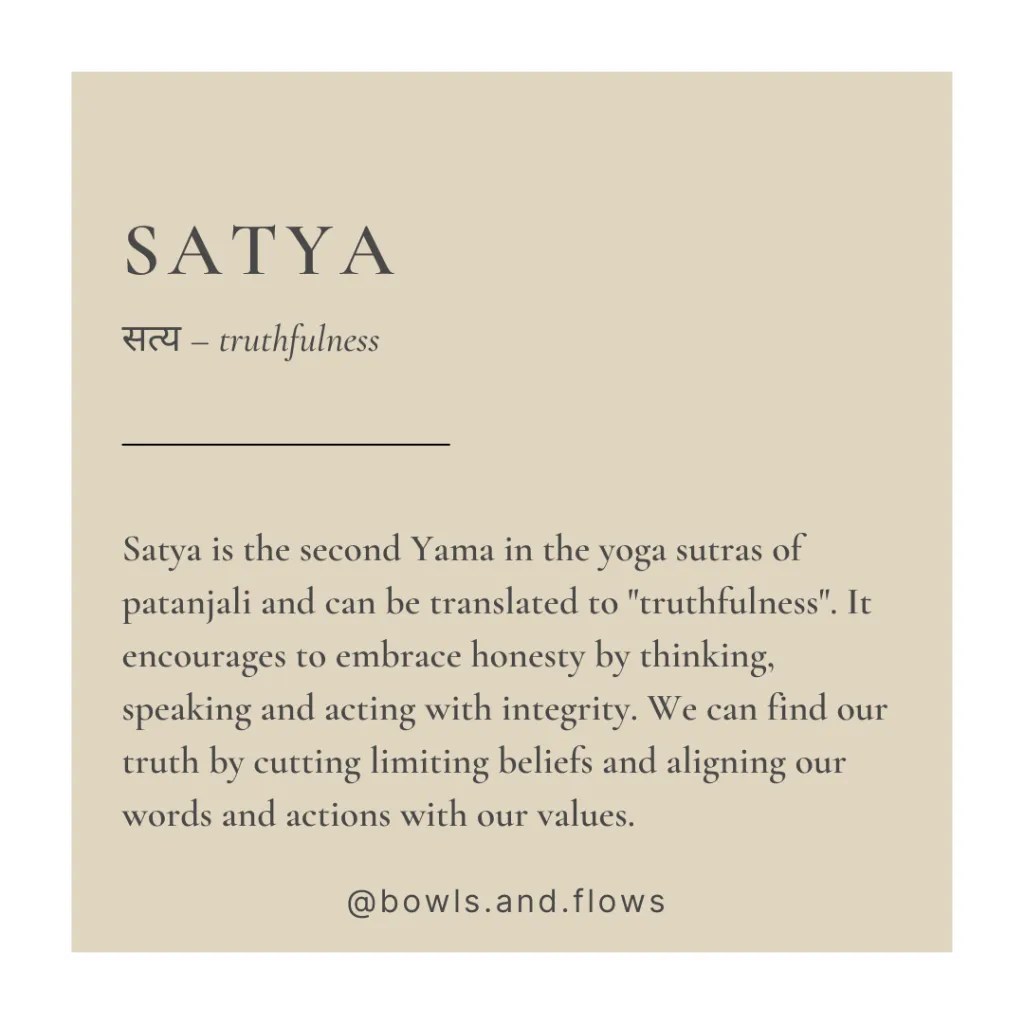
Satya, the second principle of Yama, centers on the concept of truth. At first glance, this moral guideline appears straightforward and simple to uphold. However, I find it to be a nuanced challenge in both my yoga practice and my Christian faith, particularly when I apply Satya to the internal dialogues I have with myself regarding my identity and how I interpret my lived reality.
For example, I was raised in a family environment that imposed silent expectations of service to others. Consequently, our “yes” seldom represented an authentic “yes,” and our “no” rarely conveyed a definitive “no.” I learned through codependency and a rigid framework of guilt that I was called to forsake my own needs in service to others. This often resulted in acts of service that were not entirely truthful; they were transactional in nature, rooted in the assumption that both parties would mutually abandon themselves for the sake of the other. Such an arrangement inevitably led to disappointment and resentment when the unspoken expectations went unmet.
Similarly, in my Christian faith, I wasn’t always truthful about my doubts, my wonderings, my questions. I was raised that it was wrong to question God, and by extension, any faith leader in our church. I wasn’t truthful because I was scared of being disrespectful and incurring the wrath of a vengeful God. As I matured, and especially after I became a mother, I saw God as the tender Father He has always shown up to be in my life. Just like I tolerate and even welcome the curiosities of my children, which point to their growth and independence, I know that God created me with my own curious mind and He wants my love and obedience to be born out of an intentional decision, not simply blind loyalty. There is not relationship in that.
I have also had to have heart-to-heart conversations with myself to discover the lies I was believing about myself. When I became divorced after 10 years of marriage, there were lies I told myself about my worth, my diminished value, my spotted reputation and the bleak future that lay ahead of me. My sons were very small and I lied to myself about my failings as their mother. But none of these things were the words of my loving God. They were comparisons, judements and expectations that I had absorbed from others. I got very serous about my journaling life and was able to reflect on the truth I knew about myself, even in the face of uncertainty and fear.
Satya in Parenting
Creating a Safe, Truth-Filled Home
Both yoga and the Christian faith value trust and transparency in relationships. A Christian home shaped by Satya is one where:
• Children feel safe telling the truth.
• Parents admit when they are wrong.
• Forgiveness and grace are practiced regularly.
Being Truthful in Love
Christian parenting underscores the importance of truth within the framework of love and grace, much like how Satya in various traditions is guided by Ahimsa (non-violence). Telling the truth is not synonymous with being harsh or blunt; it is about communicating in ways that uplift and build up. Parents should convey the truth to their children with gentleness, avoiding shaming. I must dedicate myself to being open about family challenges, current societal issues, and the dynamics of my marriage with my husband.
As a Christian mom embracing Satya, I strive to exemplify honesty in my everyday life—normalizing the admission of mistakes, avoiding lies (even “white lies”), and remaining true to my word. This approach fosters trust and dependability. I aspire for my sons to value being individuals of their word, but I cannot expect this without modeling such behavior myself.

Satya in my everyday life
| Truth in love | Speak openly but gently. Truthful words do not need to be blunt or harsh. |
| Consistency | Be the same person in and outside my relationships |
| Vulnerability | I share my real feelings, even if I am uncomfortable or scared of the reaction. I am learning to let their feelings be theirs. |
| Transparency | Avoid secrets, even “small” ones. If I want to be fully known, I must be fully brave to be known. |
| Receptiveness | Accept my partner’s truth, not just my version or what I hope it will mean. I need to be honest about understanding how he is receiving me as a spouse, not just how I intend to come across. |
Satya in Scripture
“Speaking the truth in love, we will grow to become in every respect the mature body…” (Ephesians 4:15)
“The Lord detests lying lips, but he delights in people who are trustworthy.” (Proverbs 12:22)
“Therefore each of you must put off falsehood and speak truthfully to your neighbor…” (Ephesians 4:25)
“Above all, my brothers and sisters, do not swear—not by heaven or by earth or by anything else. All you need to say is a simple ‘Yes’ or ‘No.’ Otherwise you will be condemned.” (James 5:12)
God calls us to radical truthfulness—you shouldn’t need to prove you’re honest. Your word alone should be trustworthy.

Journal prompts for Satya
Have you ever been an “if-when” person? “I’ll be happy if…. ” “I’ll forgive them when…” “I can focus on myself when…” This kind of thinking takes us from the truthfulness of the present and focuses on a hypothetical future that may or may not come to pass. Instead, having truthfulness about our state right now and finding peace and grounding as things are will help us lead a more authentic life. We can share of ourselves now because now is all we have. The rest is yet to be seen. Here are some journal prompts that can help you discover Satya in your faith and your yoga practice:
- What inspires you to be honest?
- When is it ok to lie to yourself or others?
- What untruths have you lived in that keep you in a perpetual state of discontent or suffering?
Satya inspires me to live a truthfully authentic life & come from a place of honesty in all things. Not only should we value Our Word, our integrity & our reputation, but we should also not delude ourselves into false narratives that justify behaviors or feelings. We cannot always focus on how we wish things were, but rather, accept them for as they are. This is especially true for how we see ourselves now versus after changes may occur.
I would love to hear how Satya is being practiced in your own life? Your yoga practice and your Christian faith. Leave a comment below to inspire others!


Leave a Reply