
“I know what it is to be in need, and I know what it is to have plenty. I have learned the secret of being content in any and every situation, whether well fed or hungry, whether living in plenty or in want.” Philippians 4:12
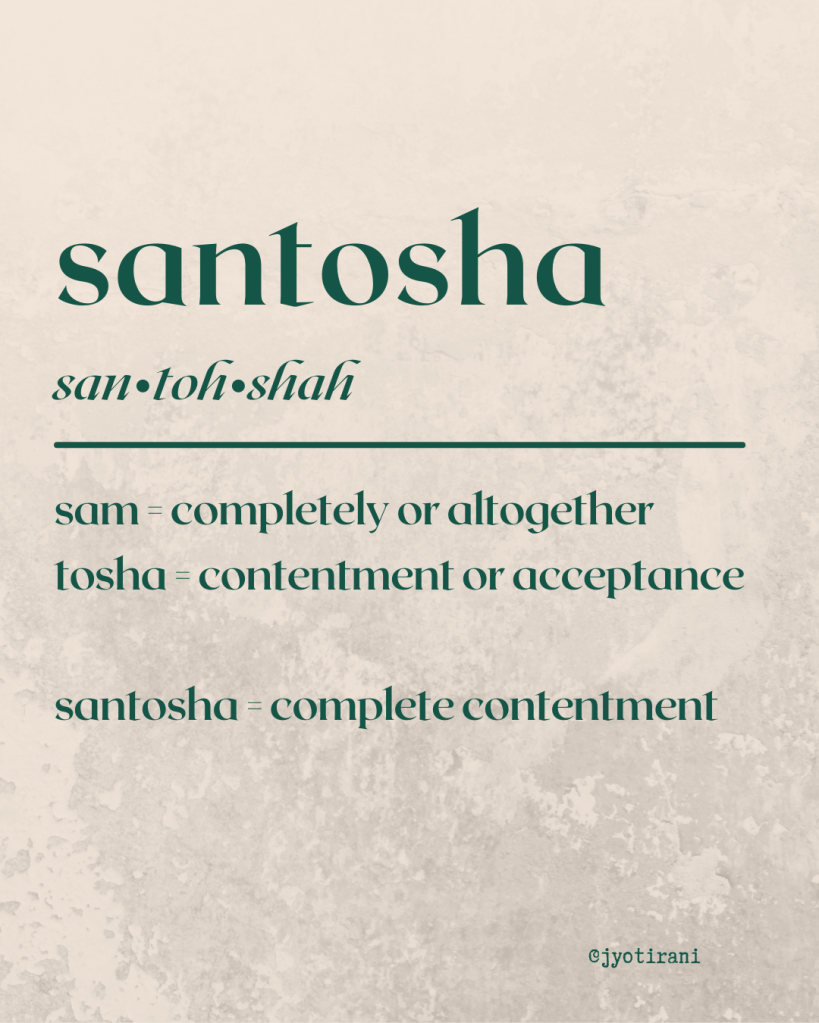
The 2nd element of Niyama is Santosha, which translates to “contentment.” In yoga, this can be easier than practicing it in life. We are called to be content in the moment, with where we are and what we have.
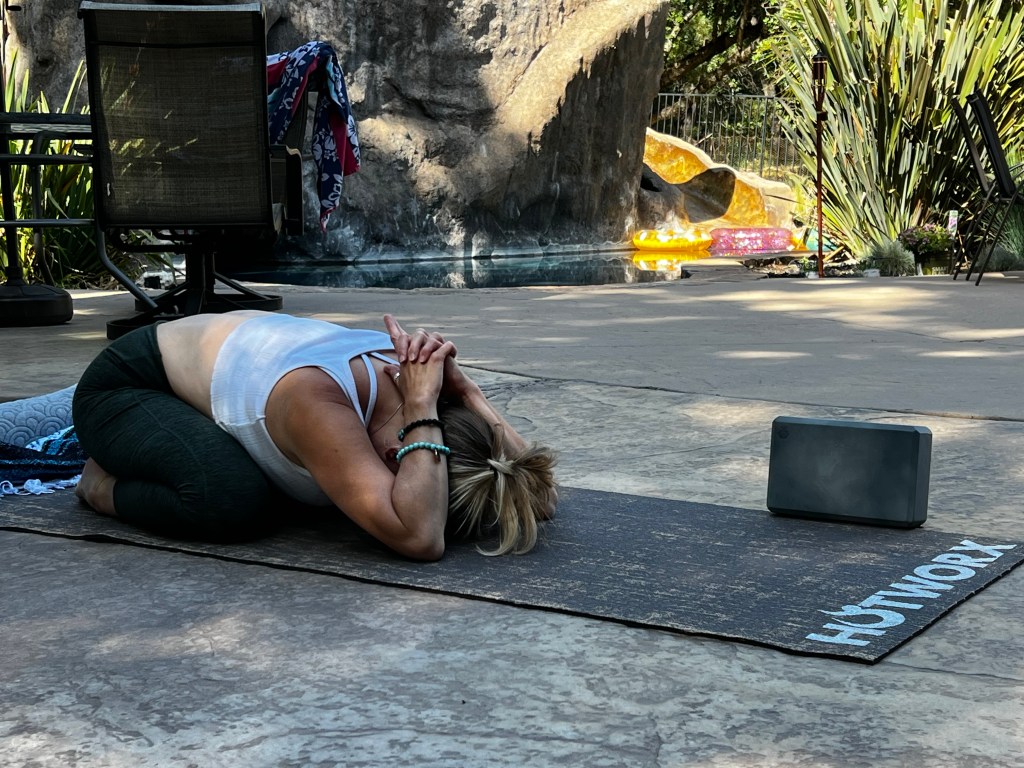
That also means being content with the body I am currently in, treating it with generosity instead of judgment, kindness instead of criticism, and gratitude instead of comparison. This is the vessel I was given by God, and as it changes – especially now in my 40s – I cannot cling to what it was or what I hope it will be in the future. It is serving me now, in so many ways.

Santosha in the Bible
“You must be willing to wait also. Be strong in your hearts because the Lord is coming again soon.” James 5:8
Contentment is addressed in different ways throughout the Bible. Even the 10th Commandment instructs us not to covet someone else’s life, including their belongings. But when it comes to faith, this can take on many different layers for me. It isn’t just about material possession. Santosha requires me to look at any place in my life where I feel lacking or less than.
Jesus lived a life of contentment and was the embodiment of Santosha, teaching it to his disciples and any of his followers. It wasn’t just about living with less material possessions, it was about not rushing the path you are on or comparing .your journey to anyone else’s.
“Take care, and be on your guard against all covetousness, for one’s life does not consist in the abundance of his possessions.” Luke 12:15
There may be times in life when I think God is working in others’ lives quicker than mine, or that their requests and desires are coming to fruition and I am being asked to wait. Santosha in my faith means that I am content exactly where I am, as I am, and I trust that when the time is right for things to change, God will present people, places and things to help me accomplish the next step. There is great comfort in knowing that I cannot change my circumstances to be like someone else’s by my sheer will. The greater work, the greater strength is to be still and find contentment in the now.
Santosha in Life
“I know how to get along with little and how to live when I have much. I have learned the secret of being happy at all times. If I am full of food and have all I need, I am happy. If I am hungry and need more, I am happy.” Philippians 4:12
Sometimes, I find myself comparing my faith, or how I express my faith, to other people.
Sometimes, I find myself comparing my home, car or vacations to my friends and family.
Sometimes, I find myself comparing my body to what it used to be when I was in my 20s or someone on social media.
Sometimes, I find myself comparing my parenting to that of others.
Sometimes, I find myself comparing simple things like how I spend my time or the decor in my house.
Sometimes, I find myself comparing my yoga practice to others that seem “better at it.”

All of this breeds negative self-talk and a scarcity mindset. It keeps me in a perpetual state of lack and want, which makes contentment an impossible goal. Instead of focusing on where I am now, or being grateful for how far I have come, I focus on where I am not or how further I still have to go. While this is a natural human condition, daily yoga practice off the mat is a great way to cultivate my mind to bring it back to contentment.
Santosha is the practice that counters all of that. And because it isn’t always easy, it is a daily practice. I haven’t gotten good at contentment, but it does get easier when I remember that I am the boss of my own mind. If I find myself making lists of lack, or comparing to what I see in my life or on social media, I can practice my breath. I can return back to my body. I can list three things that bring me joy. I can reflect on how my unique journey brought me to this exact moment in time. I can greet this life with gratitude first, requests second.
“A cheerful heart is good medicine, but a crushed spirit dries up the bones,” Proverbs 17:22
Santosha in Yoga
It is really easy to lose heart in the comparison game. We are always carrying around access to social media, reminding us that there is someone out there that is thinner, fitter, stronger, wealthier and overall different than us. “Comparison is the thief of joy,” said Teddy Roosevelt, but how do I avoid it? I can’t. The goal is to make discontent less powerful by removing it as the driver of my decisions.
Comparison is a natural part of being human – from being a toddler and comparing colors & shapes to comparing our goals and achievements into adulthood – but when it takes over our thoughts, and drives our self-image, I lose my joy.
There has been more than one yoga class in which I saw the neighbor on the next mat as better or more flexible. As a yoga teacher, when I take other teachers’ classes, I compare myself to how they speak, their dharma talks, their flow sequence and their confidence. So Santosha, again, is a mindset that can be practiced and strengthened, making these pervasive thoughts quieter and quicker, and hopefully one day, gone all together.
Think About It
- Take a look at your surroundings and habits. What helps you feel wholly and beautiful and complete? What pulls you to a place of comparison and discontent?
- How did your unique journey prepare you for where you are in life right now?
- What is something you can do to appreciate your body in your next yoga practice, on or off your mat?
- Meditate on ways in which you are operating from a place of lack or scarcity mindset. Pray about ways to change this perspective to one of Santosha and gratitude.
I would love to hear how Ishvara Pranidhana is being practiced in your own life? Your yoga practice and your Christian faith.
Leave a comment below to inspire others!


 Recklessly Hopeful
Leave a comment