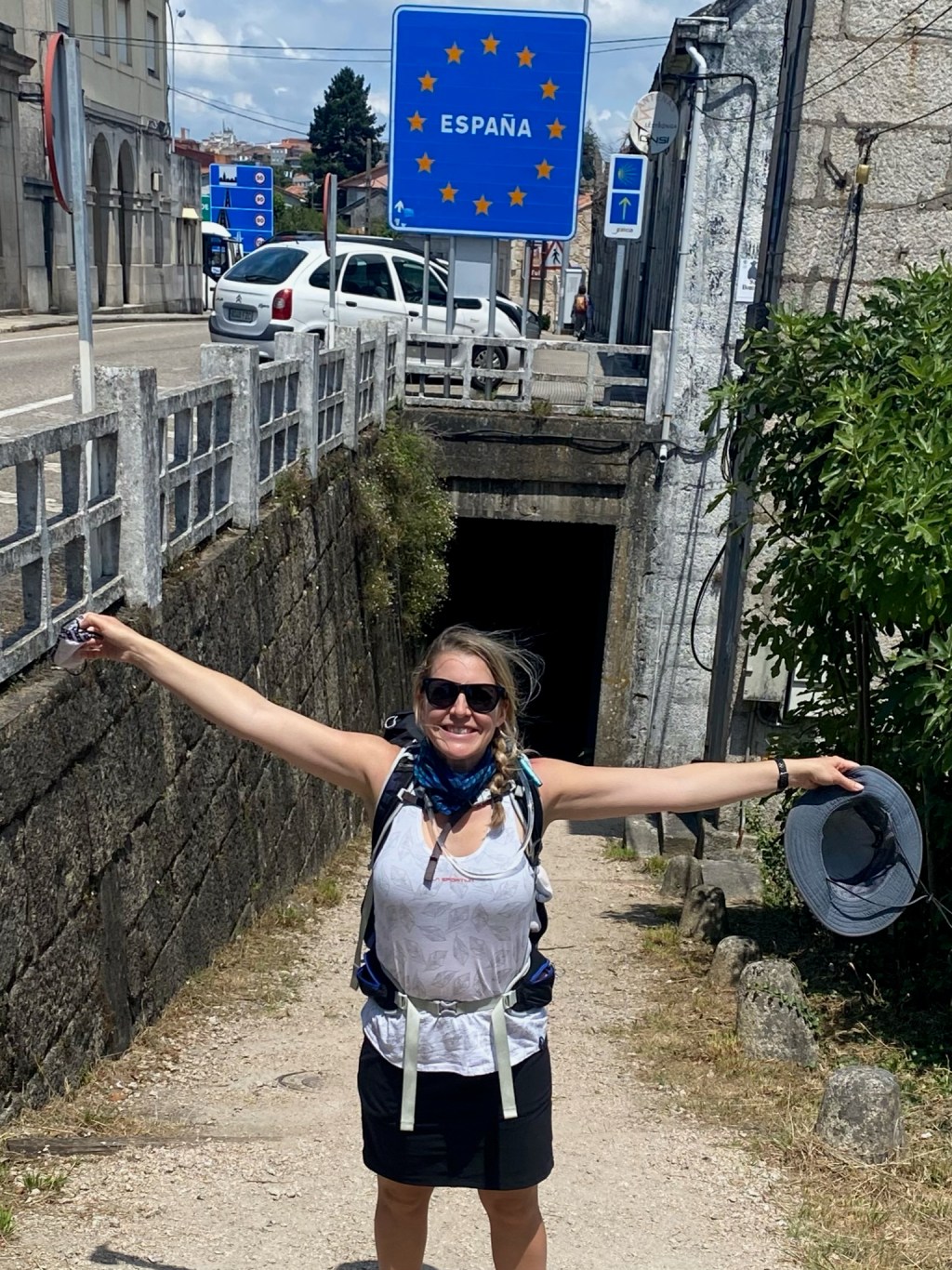
14 miles from Rubãis, Portugal to Tui, Spain
“I know a new love and acceptance of myself and others. I feel genuinely loveable, loving and loved.”
There was something mournful about leaving Portugal. I couldn’t really put my finger on it, but it lay somewhere in the details of forests, friendly faces, and quiet paths, which had turned into cars, honking, crowded Camino streets full of other pilgrims, and a commercialized stretch to the finish line. I wrestled with my body and even more with today’s CoDA promise.
We exited our garden hotel at 6:50 am and disappeared into the fog. The fields held the possibility that today would be an easier day. The cobblestones and uneven pavement continued to rip through my right hip as I compensated with the left. My ankle began to feel equally traumatized, and I found myself in a cycle of negative self-talk and a poor mindset. “This is walking. How are you having a hard time walking?” I had not packed hiking poles because I carried my pack on the flight, and poles would require checking. On this day, I realized that my need to control the situation was the only thing keeping me from that much-needed aid. I committed to finding poles before the end of the day to help relieve the pressure on my lower joints, but I struggled with the idea of “defeat.”

As the sun lifted and the fog melted away, someone was playing an accordion to welcome us out of the forest, and we stopped to marvel at the choice. Someone woke up, came to the creek with their instrument, and serenaded the plants—probably just for us. It was a melancholy dervish song to pull us from one chapter to the next.

At mile 6, we enjoyed a soup and iced tea (cake waffle, and wine for my hiking companion) at a small cafe in the middle of the trail, close to absolutely nothing else. We relished the company of a few pilgrims who caught up to us from last night. They were only the second group we had seen on the road, and the most conversation we had had with other Pilgrims thus far. These men were from Greece and visibly shocked when we told them from the United States. “What are you doing here?” was their first question.
“Oh! So you have the <COVID> vaccine!”
“Yes. It was mandatory to leave and come to Portugal.” I replied, wanting to get out of this conversation in the cleanest way possible.
“How many people in America have been vaccinated? We are waiting for it to come over here,” he pursued.
“Oh, it’s available to anyone, but if you tell Americans we have to do something, then many people just won’t do it. I know, it’s awful.”
“Oh, well, our government says that when America has reached over 50% vaccination, they will send some over here.” American exceptionalism is built int our bone marrow, but the majority of the world does not agree with this view in almost any perspective.
I felt some shame and embarrassment as they told stories of people waiting to pay for something that was freely offered and freely given in my country. This was the beginning of many such conversations for the rest of the trip. These travellers had lost parents, siblings, aunts and uncles to the virus, and they were desperate to have something that many people back home turned away from for a myriad of reasons.
Onward we walked into the trees, seeing for just a second how the world sees us and reminding myself to be a better representation of humanity.
Walking over the bridge to Spain was emotional, and we both tried to find language to share. Portugal was so welcoming and helpful, despite our language limitations. It was a warm place to develop as a pilgrim. Spain held promises of the unknown, of more foot traffic, and our ultimate finish line. But it was new. It was unpredictable and uncomfortable. Even though I had studied Spanish extensively in high school and college, including living in Sevilla, Spain, to study after my freshman year of college, the intolerance was not abated. We didn’t feel ready to leave Portugal’s fields and hamlets for busy Tui life and the chance to run into other Pilgrims. Communing with others is a foundation of the Camino, but the little interactions we have had along the way made me feel drained & imposed upon. This was also on the heels of 9 months of COVID isolation, where I had hunkered down with my immediate family, and crowds were all but extinct. The aftermath was a feeling of selfishness and disturbance.


I did not want any more outside contributions on my pilgrimage, so I was not looking to involve myself in anyone else’s. Even D’s. I was grateful she felt the same, and we stayed off to the side of any obvious Pilgrim gathering at coffee shops, park benches, hotels, and restaurant outdoor seating. We were unmistakable, with our waxy skin, slumped posture, pilgrim footwear, and large packs, and still, we stayed away from our people.
Today’s CoDA promise was hard for me to feel because I was utterly offended that my body was coping so poorly. I planned and trained for tired feet, blisters, chafing, jet lag, and other plagues found in the Camino Facebook groups. But I didn’t think my hip or ankle would give out this way. And on the heels of my birthday? The audacity!
I felt crushed at the thought of another 62 miles in these conditions. So, having a “love & acceptance” for myself seemed to be hard when I had expectations of my body that it struggled to fulfill. There: the trap. Expectations.
In codependency, “expectations” is my boogie man word. It is the idea that I can somehow prepare myself for things to come, behavior I will receive or not, and emotional currency I can exchange for a predetermined outcome. If I treat people the way I want to be treated, then I can expect them to return in kind. If I put in the work for family relationships, I can expect them to prioritize me the same way. If I keep myself available to be helpful, happy, and kind, then I can expect to always have a seat at the table. To be non-disposable. Non-replaceable. Those words are my kryptonite.
This kind of expectation has let me down, and though I had only been in the CoDA program for 14 months, I knew it was a problem I would be tackling for years to come.
So, how do I feel lovable, loving, and loved when I cannot control how others communicate my worth back to me? How do I turn these adjectives inward and make it an inside job? How do I accept that those who can only love me within their own limits should not be expected to do more? I know I am loving, but how do I use that love to manipulate their behavior to go beyond what they are capable of? I know I am loved, but I still chase family relationships that have obvious, consistent, and unwavering limits. And I know I am loveable, but only when I am the Good Girl, the Happy Girl, the Helpful Girl, the Sacrificial Girl, the Easy Girl. I needed to meditate on how I am lovable, just as I am. Flaws and all. Good days and bad days. Quiet days and laughing days. Days when I say “yes” and days when I say “no.” How do I believe I am lovable as a full, authentic woman? The way God made me. He made me in His image, not anyone else’s.
In my family of origin, I was the easy one. The middle child and only girl, I was quick to understand that the landscape of my home was easier to navigate when I was the Good Girl. Helpful, cheerful, read-the-room kind of female. I knew the rules and complied in advance. Apologize often and smile always. As an adult, I am the only sibling who completed higher education, funded solely on my own, and am successful in a conventional way. I am an English professor, social planner for our friend group, advocate for family tradition, and creator of memories and mother to three sons. And yet, I am the butt of most jokes when my brothers come around. The energy shifts, and my stocks plummet. I am the cartoon lamp that no one takes seriously. Laughing along is the best way to ride those waves. I mean, if this is how they treat me when I go along with it, there is no telling what would happen if I stood up for myself. In this way, I have not been lovable to them or to myself.
“I know a new love and acceptance of myself and others.” If I don’t accept people in my life for who they are, how they show up, and how they are limited, then why should I expect them to do the same? (! that word !) If I try to hold them to a standard they can never meet with real consistency, how am I setting us all up for disappointment, resentment, and failure?
They will never understand my experiences & perspectives about living abroad, marriage, divorce, and remarriage. They mock my understanding, passion, and curiosity for yoga, energy, moon cycles, and earthing. My husband embraces, encourages, listens to, and is curious about the things I am curious about, and that comes from a place of love. He will happily drink the Moon Water the day after the Full Moon, and buy more incense when he sees I am running low. He doesn’t feel the same pull to these things, but he communicates love and care by making space for them in our life together. That is something my family is incapable of doing. No amount of Good Girl behavior will help them see me differently or treat me differently. I cannot manipulate or control that.
“I know a new love and acceptance of myself and others. I feel genuinely loveable, loving, and loved.”
I cannot believe how well I am now loved or how I ever accepted less as “good enough” from a romantic partner. How I found so much joy and life surviving on the crumbs of affection when I am sitting at his Thanksgiving feast of adoration, respect, and care. It is now easier to accept this gift from my husband, but giving it to myself is so much harder. Maybe Promise #5 will be easier as I accept my body’s ability instead of judging it.
Maybe buying poles in Tui is a sign of respect, not surrender. Maybe giving my body more food and rest is an act of self-love instead of a time-consuming annoyance. Maybe starting in my own soul is the answer to feeling “loveable, loving, and loved.” Honoring the way that God is revealing these truths in such a tender and soft way reminds me that His fatherly love is the ultimate source of my worth.
My expectations are shifting, my scars peeling like summer skin, and my journey is only halfway finished. And I bought myself some poles. I named them Barbara.


 Recklessly Hopeful
Leave a comment