As a born-and-raised Christian (like the 1990’s Christians… not Christian Nationalist), I was brought up on the teachings of Jesus. I also attended a Baptist elementary school in which we had a healthy dose of guilt, shame, and judgment. The latter was practically a course requirement, but when you are that young, it is a lobster boil that catches up by teenage years. We are all products of our upbringing, for better or worse.
I had a childhood friend in the neighborhood, Whitney, who came from a Mormon family. At the tender age of 8, I told her she was going to hell because she wasn’t a Christian. We were in my swimming pool, the only one in the neighborhood, and with 115-degree summer days, it was always full. My limited understanding was that Heaven was for Christians, and there was a large group of humanity that would be going to hell. A few days prior, I had curled up next to my dad on the couch and asked how “everyone else who didn’t go to our church” was getting to Heaven. He repeated the Baptist mantra – only Christians who believe in Jesus are going to Heaven. What my dad lacked in physical touch, he made up for in quality conversation, teaching critical thinking and patience with the endless questions of the world. For many crossroads in life, I have turned to him as an anchor. I can remember hearing his answer and feeling filled with dread. My Mormon friend was going to hell. Note: I had zero interaction, knowledge, or understanding of the Mormon faith. Whitney and I spent our time in the pool being mermaids and talking about cloud formations. In betweeen bike rides and breath-holding competitions, we didn’t discuss the nuanced intricacies of our family faiths. My family didn’t discuss other sects, except to point out that they were “other.”
My reply was brief but overflowing with sadness, “How do we know that our Bible is the right one when everyone else believes theirs is the right one too? How are we sure that we are the only ones who know the truth? How can God kill everyone else?” I was likely hysterical by that point. I don’t remember his answer and I don’t remember how I was calmed. But the next day, I told her she was doomed and made her cry. Whitney’s family moved away to an adjacent neighborhood and we didn’t remain friends. I am not convinced these two events are unrelated. For years, I worried about her soul while grappling with the exclusiveness of my family’s faith.
Unlike many, I did not have permanent scars from the Church during my teen years other than the hyper-focus on “saving” everyone I knew. My high school days were filled with community groups, lake days, friendship, camp, and acceptance. However, it created a sense of entitlement and elitism that I had to shake off later when I became more educated about the similarities in all religions and the value each brings to the lives of their believers. I actively sought experiences that would file down the sharp edges of criticism and groupthink to better understand the historical significance of differing religions. Additionally, I had to dive into inquiry to understand the devastation that Christianity has inflicted on every nation and people group. If we want to talk about zealots, mass murder and nationalism, look no further than the historical accounts of the Christian Crusades. Seriously, though…. look it up. Yikes.
I talk about my faith journey like a Boomerang: I was flung out into the world, into knowledge, and I deconstructed my blind allegiance to the God of my youth. I watched my pious family fall apart and absorbed the shunning the Church doled out without regard or understanding. By the time I was 24, I knew that the God of fear, judgment and punishment wasn’t the God I wanted to devote my life to. The common thread that connects the teaching of Jesus, Buddha, Ghadi, Sufi poets, Jewish proverbs and Native American wisdom was to be the beacon that turned the Boomarang around when I moved away from home.

I started at a Unitarian Church in Seattle and tip-toed back into a faith mindset. I have never denounced the existence of God, and I still believe in the Salvation narrative. But Christians were doing nothing to keep me in the fold. I appreciated that the community of Unity Church in Seattle gave equal pulpit time to the aforementioned doctrines and texts as to the Bible. The speaker (is it a pastor??) always threaded in common ways in which we could be more gentle with ourselves and empathetic to the world. This was what I was looking for. Less “us versus them,” more “all one human race.”
Raising kids & teaching in Christian Higher education in the last 10+ years has made me commit to defining my faith in real and tangible ways. I am a Pro-Choice survivor of SA. I am an empathetic ally to the LGBTQ+ community. I am an original WWJD bracelet owner who still believes in that question. I honor the dignity of pronouns. I will own my whiteness and fully understand that I don’t understand the pain, loss, and detriment embedded in the histories of black and brown people. (note: White people were the first undocumented immigrants flowing into the borders, just FYI). I work hard to educate myself on the experiences of others. I teach and practice critical thinking skills with my students and my children. So when it came time to talk about my faith from the lectern, I felt a strong responsibility to authenticity and the journey. It no longer stayed in the bubble of Biblical truth – which is highly historical, allegorical and translated poorly.
I started practicing yoga in 2018 as a way to dig myself out of the postpartum depression that swallowed me whole. I cried on my mat for months at a time, until the suffocating clouds began to part. In 2023, I decided to use my curiosity to learn about the yoga philosophy and become a certified instructor. Like Christianity, I saw a false picture of yoga being portrayed: skinny, bendy, and white. Social media made yoga intimidating and inaccessible to many shapes, ages, and abilities. I was so curious how a tradition older than Christianity could be so narrowed down by influencers.
Through studying the 8 limbs of yoga, I returned to the benches of Seattle’s Unity Church in my heart. A safe place, open for everyone. I saw the similar pathways to peace offered by Jesus’s teachings and the accessible way we can be a light-filled contribution to human nature. I had a deeper understanding of myself and began to honor my body in a new way. Instead of listing the ways it was failing, misshapen, or needing more discipline, I praised the way it carried me throughout each day, regardless of how I mistreated it with late-night scrolling, minimal water, and too much negativity. Instead of complaining about cleaning up after the kids, I practiced Saucha as a way to be grateful for the space we live in. Instead of giving to relationships that were dead or non-reciprocal, I practiced Brahmacharya, which teaches the right use of energy. Instead of worrying about something completely made up in my mind, I practiced Aparigraha, non-attachment.
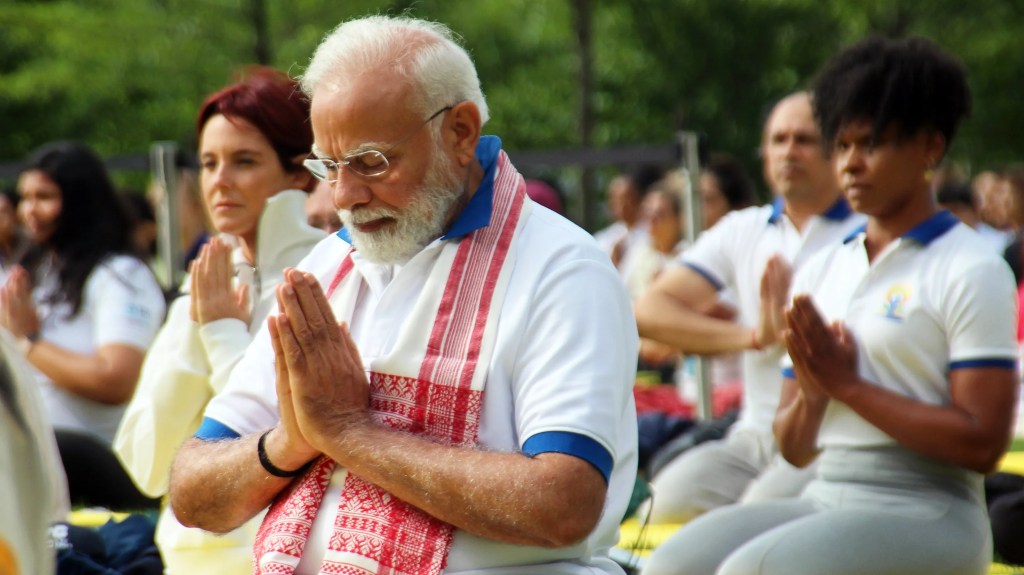
On my mat, I feel the closest to God. On my mat, I learned that meditation is listening for God’s voice and praying is talking back. The conversation with God became a two-way street when I shut up long enough to sit in the discomfort of a meditative posture. I learned that pain is inevitable and suffering is a choice. I read Tolle and Bhagavad Gita and found stillness and non-attachment. I no longer focus on outward sources of value, or at least I try not to. For this same reason, I accept that missteps and unhealthy choices simply highlight my need for Christ in my life, a reliance I will never outlive. The same way yoga philosophy highlights progress over perfection – once you get to the final limb, you start over again because you are constantly becoming a different version of yourself.
Many in my faith system told me that yoga was counter to Christianity and served as a gateway to Satan entering my life. I responded, “Was that your experience? How scary! I have never met Satan on the mat, but I have heard God’s voice.” (Note: a personal philosophy is to answer judgment with curiosity. It usually does more good than arguing and persuasion)If you are a skeptic, if you think it isn’t for you, I am here to encourage you.
What living your yoga looks like: sitting in your car at a stop light, radio off, and listing the things you can see, smell, hear and taste (Brahmacharya), being still on the back patio with your coffee and allowing your mind to wander without attaching to any one thought (Dhyana), physical shapes at home or a gym or studio (Asana), cleaning your house (Saucha), reading your previous journals to honor how far you have come (Svadhyaya), praying with my husband before he leaves for work (Bhakti). And so many, innumerable ways.
My faith and my mat are one and the same. I am a less-effective Christian without yoga, and I am a distracted yogi without Christ. If you find yourself trying to choose one over the other, I invite you to throw off your preconceived ideas of one or the other, and research the true benefits of both. Unless Satan meets you on the mat… then, choose a different adventure.

 Recklessly Hopeful
Leave a comment